Microsoft Edge now lets you create AI images using the power of Dall-E

misty dark clouds in black sky

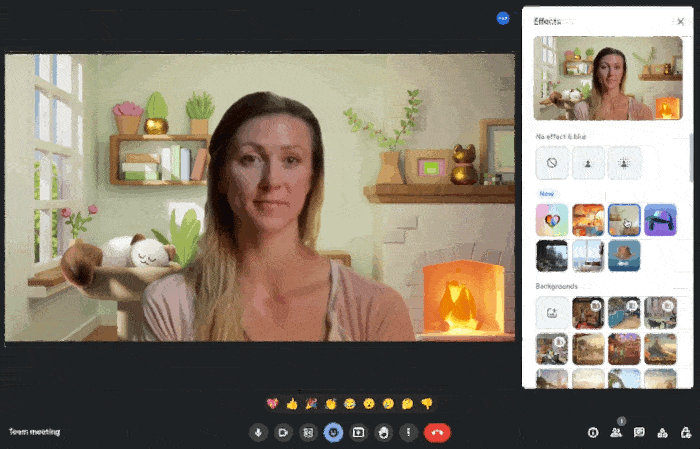
Microsoft isn’t slowing down when it comes to adding AI-powered tools to its various products: the company has announced that image creator Dall-E is now available for everyone to use via the sidebar in the Microsoft Edge browser. “This feature will help you create images that don’t yet exist, powered by the very latest Dall-E … Read more

Affiliate Marketing Strategies for Tech Rookies.

roll of american dollar banknotes tightened with band

Building an affiliate marketing website can be a great way to earn passive income by promoting products or services of other companies and receiving a commission for every sale made through your referral link. Here are some steps to follow to build an affiliate marketing website: Building an affiliate marketing website requires time, effort, and … Read more

Not an ordinary laptop: the world’s most powerful mobile workstation bundles 192 cores, up to 3TB and six monitors

photo of white and purple painting

Almost three years after the launch of its a-X2P Rome-based portable mobile workstation, MediaWorkstation has a refreshed model, arguably the most powerful integrated transportable computer in the world. 

It is not a laptop or a mobile workstation in the true sense; it is closer in its design to an all-in-one PC, similar to the luggables of yesteryear as it doesn’t have any internal battery; you would probably only get 10 minutes usage at most with one of our best portable power stations.

More Deals Here

Ideal for what the boutique PC vendor calls “highly multi-threaded applications in the field”, the new model has been upgraded to support AMD’s EPYC Genoa based on Zen 4. That means two EPYC 9654 CPUs, each with 96 cores, up to 12 x 256GB memory modules (totaling 3TB of DDR5 memory).

You can plug up to two full height, full size GPUs (or accelerators), one M.2 NVMe boot SSD and five storage drives. All this is cooled by half-a-dozen fans and a power supply unit of unknown capacity (likely to be closer to 2Kw). The motherboard used is likely to be the recently-launched Gigabyte MZ73, a rare e-ATX dual-socket SP5 model. 

There’s plenty of ports but no Thunderbolt 3 or 4

There’s plenty of ports, but no Thunderbolt 3 or 4 connections, which is a surprising omission given the wide variety of use cases that would make good use of that. In the absence of any wireless connectivity options, a pair of 10GbE connectors will ensure that this mobile studio can connect to the outside world.

Pictures show five 5.25-inch drive bays and a slot-in optical drive, seven slots for PCIe devices and legacy ports such as DVI and PS2.

The a-X2P can also be used with six 24-inch monitors (up to 4K and 1000 nits brightness), a configuration that will push the weight of the mobile workstation to 55 pounds. Each workstation comes with a touchpad and heavy duty mechanical keyboard which folds up onto the display for transport as well as a thick, sewn vinyl wheeled carrying case.

We’ve reached out to MediaWorkstation to find out whether the a-2XP actually supports 6TB as it is mentioned in the tech specs that it is compatible with 256GB 3DS RDIMM DDR5 Modules.

Expect to pay at more than $200,000 for a top-end, fully kitted mobile workstation that will rival any desktop bound workstation PC or video editing PC. You cannot configure any products online and you will need to go through a form or do it over the phone – which is understandable as such a niche player will want to weed out time wasters and focus on serious customers instead.

The company also sells portable Xeon-based workstation PCs, both in single and dual socket variants (i-X1P, i-X2P), and single-core AMD EPYC-based and Threadripper Pro ones (a-X2P, a-XP).


Read more

Forget AirPods and Spatial Audio, these new, cheaper earbuds have ‘RoomFeel’

J8KGWj3yBwjkfW7GHUTY34

Canada’s PSB Speakers is a company best known for making loudspeakers, but it’s also been designing and manufacturing headphones for the past 10 years. The latest additions to its portable audio lineup are the M4U TWM true wireless earbuds and M4U 9 wireless ANC headphones, both of which feature the company’s proprietary RoomFeel processing and Audiodo Personal Sound technology.

We’ll cover both those features in a bit and lay out what makes them special, but let’s first discuss details of the new models, which offer many of the conveniences we expect of the best wireless earbuds and best wireless headphones.


The M4U TWM true wireless micro planar earphones ($199 / £199 / around AU$300) use “powerful Magneto-Static technology in a Hybrid Planar dual driver design,” according to PSB. Separate transducers deliver the high and low frequencies, and aptX Adaptive Bluetooth enables a latency-free wireless connection. Both earbuds feature hard click buttons for playback and volume control and a USB-C charging case allows for a maximum 32 hours of playtime with up to 8 hours out of the case.

PSB’s M4U 9 premium wireless active noise-canceling headphones ($499 / £449 / around AU$750) are an over-ear closed-back design that uses new graphene-infused drivers which the company says “improve on damping, stiffness, and efficiency.” Like the M4U TWM these have aptX Adaptive Bluetooth for a wireless connection, while 4 digital MEMS microphones deliver noise-free ANC listening and two extra mics enhance voice clarity during phone chats.

The M4U’s three-position switch will let listeners easily select between ANC with RoomFeel, Active with RoomFeel, or passive modes, and listening time extends up to 25 hours with the headphones in active mode.

RoomFeel Tuning and Audiodo Personal Sound 

PSB’s proprietary RoomFeel tuning, now in its second generation, is designed to eliminate the “in the head” effect many headphones create and instead make it seem like you’re listening in an actual room with the best stereo speakers. Part of this process is applying the “energy and warmth” that a typical room adds to the sound response curve, which in turn makes music sound more natural.

Audiodo Personal Sound is a tool that uses algorithms to calibrate sound output independently for the listeners’ left and right ears. The process is carried out via a hearing assessment using the PSB Headphones app, which will then create a sound compensation curve customized to the listener’s personal hearing abilities.

Woman wearing PSB M4U 9 headphones in outdoor setting

PSB’s M4U 9 over-ear headphones (Image credit: Future)

Analysis: Headphones that get you out of your head are good 

PSB’s new M4U TWM and M4U 9 are packed with most of the features listeners love about portable headphones. There’s active noise canceling tech on the M4U 9 to block out external sound when out and about and aptX Adaptive Bluetooth on both models for a low-latency, better-quality than regular Bluetooth wireless audio connection. And even though they arrive from a specialist audio manufacturer, prices for the new headphones are competitive with similar options like the  AirPods Pro 2 and AirPods Max.

What’s most intriguing to me, however, is PSB’s proprietary RoomFeel feature.

Many headphones in my experience really do create an “in the head” effect where it seems like the sound is centered in your skull. That’s not the way we encounter sound in the real world, of course, and it’s not the way we typically experience music at home on speakers, or out at concert venues where there are musicians performing onstage.

Dolby Atmos music (aka Spatial Audio) makes the experience of listening with headphones more engaging because the presentation becomes 3D-like, with sound expanding outward from the zone between your ears and also seeming to emerge from positions in front of and behind your head. But not all music is available in Spatial Audio format, so it’s only a partial solution to the “in the head” effect at present.

I tried PSB headphones with the first generation of RoomFeel and immediately appreciated how that tech transformed the soundstage, positioning it forward in space in much the same way as I would listen to music at home on my stereo speaker system. The presentation was more natural than what I had heard from many other headphones, and having the ability to easily switch it on and off to make listening comparisons helped to confirm my preference for RoomFeel.

This next generation of RoomFeel tech doesn’t appear to be essentially different from what I’d previously experienced – the main difference is that it’s now available for wireless earbuds as well as over-ear headphones. But getting to hear stereo music on the go in a manner similar to listening with speakers at home is a winning proposition and one that should be equally impressive as Spatial Audio on my AirPods Pro 2.

Read more